Choosing an ad monetization partner is one of the highest-stakes decisions a publisher makes. The right partner grows revenue, shows you where it comes from, and keeps your setup current as the market changes. The wrong one locks up your inventory, hides the numbers you need, and leaves you a step behind every time the technology moves. This guide covers what to evaluate, in the order that matters.
What should publishers look for in a monetization partner?
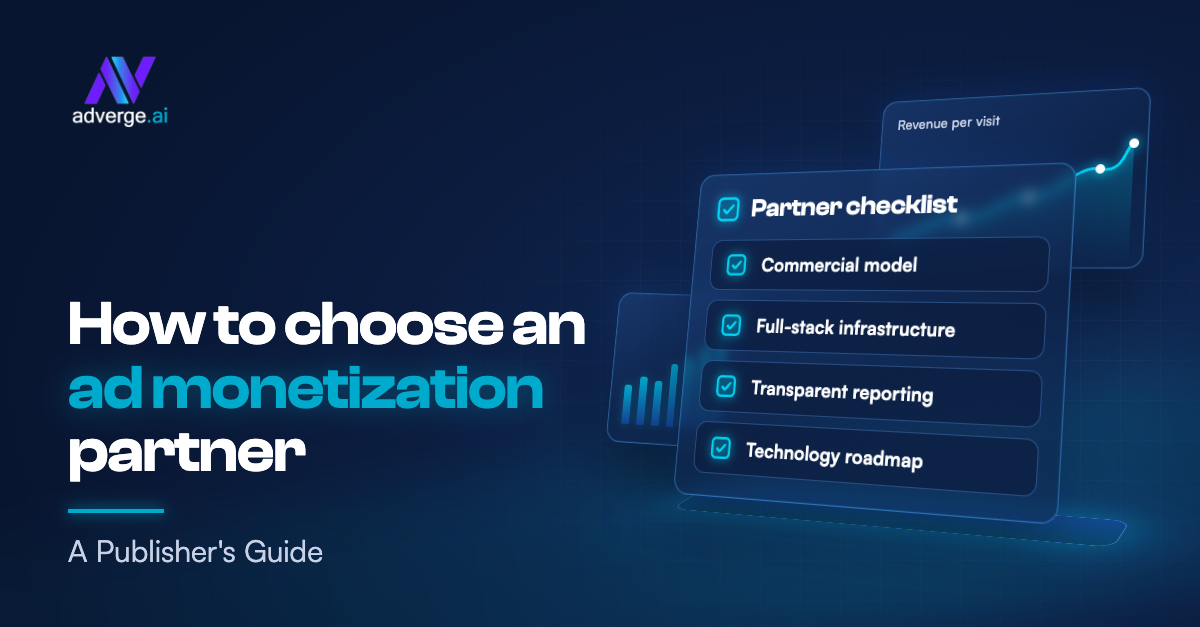
Four things: a commercial model that fits how you operate, an infrastructure approach that covers the whole stack, reporting you can actually use, and a partner that stays ahead of the technology. Demand access, integrations, and support matter too, but they sit on top of those four.
Most publisher regret traces back to one of them being missing. The demand pitch was strong, but the model did not fit the business. The wrapper was fast, but nothing else in the stack improved. The lift was real, but nobody could explain where it came from. The setup worked, until the market changed and the partner did not.
Which commercial model fits your business?
There is no single right model. The right one depends on how much of the work you want to own.
- Managed service. The partner runs monetization for you: the wrapper, demand relationships, optimization, and day-to-day operations. This suits publishers who want results without building an internal ad operations team.
- Software (SaaS) license. You license the technology and run it with your own team and your own demand relationships. This suits enterprise publishers with established direct and programmatic demand who want better infrastructure without handing over control of their buyers.
Some partners offer both, which matters as you grow. Adverge, for example, runs a managed model for most publishers and licenses its technology to enterprise publishers who bring their own demand.
Whatever the model, ask the same questions:
- What exactly am I paying for, and on which inventory?
- Can I see every fee on my own reports?
- If my needs change, can I move between models without starting over?
A good model is easy to explain in one sentence and easy to verify against your own numbers.
Why should you evaluate the whole infrastructure, not just the wrapper?
Because revenue is decided by the whole stack working together, not by any single piece. The wrapper matters, but it is one part. A faster wrapper on top of weak demand, thin audience data, and a slow page will hit a ceiling quickly.
When you evaluate a partner, look at how they handle each layer:
- Wrapper and auction. How bidders are called, timed, and prioritized, and how the supply path is shaped so the right demand competes for each impression.
- Demand access. Which buyers and marketplaces can reach your inventory, and how they are managed.
- Audience data and identity. How first-party signals and identity frameworks are activated so buyers can value your audience.
- Ad experience and page performance. How ad load, layout, refresh, and page speed are balanced so revenue per visit rises without hurting the reader.
- Reporting. Whether you can see how all of the above performs, together, in one place.
A partner that optimizes one layer can move one number. A partner that works across the full stack moves revenue per visit, which is the number that compounds. For more on why that metric matters, see why RPS beats CPM.
Ask every vendor on your shortlist: which of these layers do you run, which do you leave to me, and how do they work together?
What reporting should you expect from a partner?
Enough to answer three questions without filing a ticket: how is my business performing, where did this revenue come from, and why did it change?
Revenue usually lives in several places at once: Google Ad Manager, multiple SSPs, Prebid, and internal reports. A strong partner brings those signals into one reconciled view, so you are not stitching spreadsheets together to understand last week. Look for:
- One view across every revenue source, reconciled, not a pile of separate exports.
- Revenue per visit and per session, not just CPM, so you can see what each audience visit is actually worth.
- Auction-level detail. For publishers running Prebid, that means bid rates, win rates, response times, and timeouts by bidder. Who is competing for your inventory, who is slowing the auction down, and where revenue is slipping away.
- Drill-down, from an executive summary to detailed diagnostics in a few clicks.
- Access included. You should not need to buy a separate analytics tool to see what is happening in your own auction.
At Adverge, this is the job of Nexus, our decision intelligence platform, which includes Prebid analytics at no extra cost. Whatever partner you choose, insist on seeing the reporting before you sign, ideally on your own data.
Is the partner staying ahead of the technology?
This is the question most evaluations skip, and the one that decides whether a good partner stays good. Publisher monetization is changing faster than at any point in the last decade:
- Identity. Browsers keep limiting the signals buyers rely on, so the identity frameworks that work today may not work next year.
- Server-side auctions. More of the auction is moving off the page and onto servers, which changes how wrappers and bidders need to be set up.
- Agentic buying. AI agents are starting to plan and buy media through new protocols such as AdCP. Publishers need infrastructure that can be discovered and transacted with by those agents, not just by human traders.
- Market structure. Regulatory remedies and platform changes keep reshaping how major exchanges compete in the auction.
A partner who is building for these shifts protects your revenue as they land. A partner who is not will hand you the bill later, as a migration.
Ask:
- What has changed in your product in the last six months?
- How are you preparing for agentic buying and server-side auctions?
- Do you take part in the industry groups that set the standards, such as Prebid.org?
- When a browser or platform change hits, how quickly do you adapt, and how do you tell your publishers?
Specific, recent answers are a good sign. A slide about "the future of ad tech" is not.
What are the red flags?
A few patterns should give you pause, however strong the demand pitch sounds.
- Long lock-in. Multi-year contracts with painful exit terms. A confident partner earns your renewal; it does not trap it.
- Reporting you cannot check. Monthly summaries with no way to drill into the numbers or reconcile them against your own data.
- Fees you cannot see. Take rates that shift, bundled charges, or margin taken inside the auction that never appears on your statement.
- A demand to prune your ads.txt. Cutting authorized sellers to make a supply path look cleaner reduces the demand competing for your inventory, and less competition means lower yield. A partner can improve the supply path inside the wrapper, through traffic shaping, without asking you to cut demand. Treat a pruning request as a reason to ask harder questions.
- Data you cannot get back. If leaving means losing your audience data, you never really owned it.
- A roadmap that stopped. If nothing meaningful has shipped in a year, the market will move past you both.
How do you actually run the evaluation?
Turn the criteria above into a short, structured test.
- Write down your baseline. Know your current revenue per session, fill, and revenue by source before you talk to anyone. You cannot measure lift without it.
- Shortlist on the four fundamentals. Commercial fit, full-stack infrastructure, usable reporting, and a partner that is keeping up. Drop any vendor that fails one, however good the demo looks.
- Run a controlled test. Put the partner's full setup on a slice of your traffic, for example 10 percent, and run it against your current stack for long enough to cover normal swings, typically 30 to 60 days. Testing the whole stack on a slice tells you more than testing one feature on all of it.
- Reconcile the numbers yourself. Check the lift against your own reports, not just the partner's dashboard.
- Confirm the exit. Before you expand, know exactly how you would leave and what you would keep. A clean exit you never use is worth more than a lock-in you regret.
A partner who welcomes this process is confident in the value. A partner who resists it is telling you something.
The bottom line
Every demo sounds good. What separates a partner that grows your business from one that quietly costs you is underneath: a model that fits how you work, infrastructure that covers the whole stack, reporting that shows you what is happening, and a team that is building for where the market is going. Start there, run a real test, and let the numbers decide.
If you want to see how Adverge approaches this, Yield Cortex is our full-stack monetization infrastructure and Nexus is the reporting layer on top of it. Talk to our team about a controlled test on your own traffic.
Frequently asked questions
Should I choose a managed monetization partner or license the technology?
It depends on your team and your demand. A managed service suits publishers who want results without running ad operations in house. A software license suits enterprise publishers with their own demand relationships and an ad operations team. Some partners, including Adverge, offer both.
Is the wrapper the most important part of a monetization partner?
No. The wrapper is one part. Revenue depends on the whole stack working together: auction, demand access, audience data and identity, ad experience and page speed, and reporting. Evaluate how a partner handles every layer, not just the wrapper.
What reporting should I expect from a monetization partner?
One reconciled view across Google Ad Manager, SSPs, and Prebid; revenue per visit, not just CPM; auction detail such as bid rates, win rates, response times, and timeouts by bidder; and drill-down from summary to diagnostics. You should not have to buy a separate tool to see your own auction.
How do I test a monetization partner safely?
Run their full setup on a slice of your traffic, such as 10 percent, against your current stack for 30 to 60 days. Agree up front on what you are measuring, then reconcile the results against your own reports before expanding.
How can I tell if a partner will keep up with changes in ad tech?
Ask what has shipped in the last six months, how they are preparing for agentic buying and server-side auctions, and whether they take part in standards groups such as Prebid.org. Specific, recent answers are a good sign.
Should I prune my ads.txt if a partner asks?
Be cautious. Removing authorized sellers reduces the demand competing for your inventory, which can lower yield. A partner can improve the supply path inside the wrapper without asking you to cut demand.